
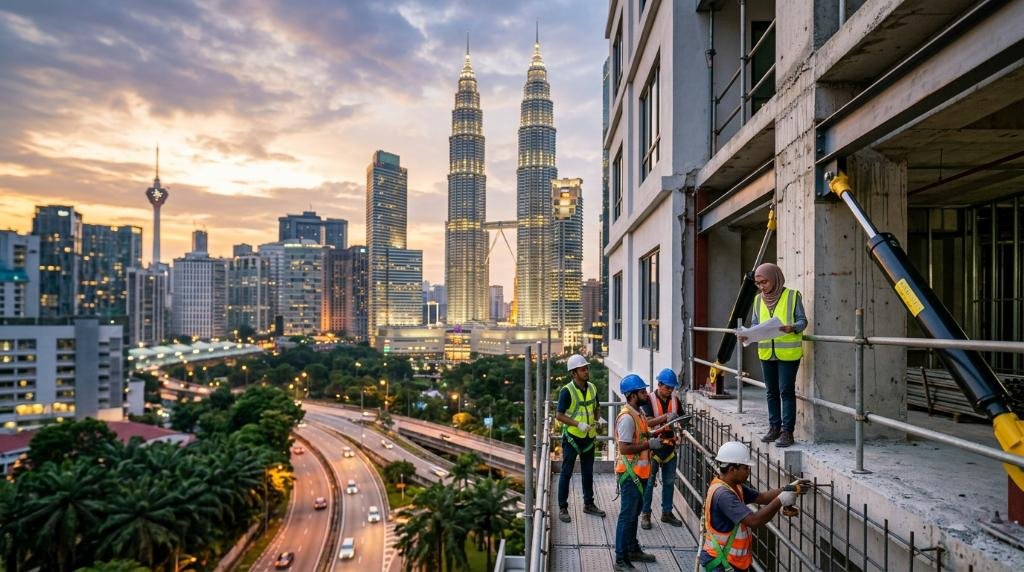
When tremors ripple through Peninsular urban centers, the immediate concern for occupants and asset managers is simple: Is this building structurally safe? This issue gained significant public attention following top-referred coverage by NST Online reporting that mild tremors prompted swift structural assessments at municipal facilities, including the Kajang Municipal Council (MPKj) headquarters. The Kajang municipal council tremors incident serves as a stark reminder that even low-intensity far-field seismic events can trigger panic and expose subtle vulnerabilities in urban civil infrastructure.
For decades, Peninsular Malaysia was treated as an inactive seismic zone, leading to building stock constructed primarily under British Standard BS 8110—a standard designed for gravity and wind forces, with minimal consideration for horizontal dynamic excitations. However, with deep alluvium soil deposits across the Klang Valley and evolving seismic research from Sumatran fault systems, the topic of building tremor safety Malaysia has transitioned from a theoretical discussion to an urgent operational requirement for property owners, Joint Management Bodies (JMBs), developers, and contractors.
1. The Seismic Reality in Peninsular Malaysia: Far-Field Tremors & Soil Resonance
Although Peninsular Malaysia lies on the stable Sunda Plate, it sits adjacent to one of the world’s most active tectonic boundary zones: the Sumatra Megathrust and the Great Sumatran Fault. High-magnitude earthquake shocks originating hundreds of kilometers away transmit long-period shear waves across the Malacca Straits. When these seismic waves hit urban basins like Kuala Lumpur, Petaling Jaya, Kajang, and Penang, they undergo significant site amplification.
In municipal zones such as Kajang, thick layers of quaternary alluvium and soft clay act as dynamic amplifiers. The natural frequency of soft soil often aligns with the natural vibration period of mid-to-high-rise reinforced concrete (RC) towers. This matching of frequencies induces resonance—a phenomenon where low-level tremors lead to amplified top-floor sways, non-structural cracking, and localized stress concentrations around structural framing joints.
The recent safety evaluations following the Kajang municipal council building tremors highlighted that visual inspection alone is insufficient to confirm structural integrity after an event. Structural engineers must examine both primary load-bearing members and secondary structural connections to verify that micro-cracks have not compromised ultimate strength or serviceability limits.
2. Structural Vulnerabilities in Malaysian Building Stock: BS 8110 vs. Eurocode 8
To evaluate building tremor safety Malaysia comprehensively, engineers must differentiate between legacy structural frameworks and contemporary standards. Most developments completed prior to 2017 were designed according to BS 8110. While robust against vertical loads, BS 8110 lacks specific requirements for ductile detailing, beam-column joint confinement, and shear wall boundary zone reinforcement required for horizontal earthquake actions.
In response to growing awareness, the Construction Industry Development Board (CIDB Malaysia) and the Department of Standards Malaysia adopted MS EN 1998-1 (Eurocode 8: Design of structures for earthquake resistance – General rules, seismic actions and rules for buildings) alongside its Malaysia National Annex (NA). This standard mandates explicit seismic load calculations and ductile detailing for new developments.
Key Engineering Vulnerabilities in Existing Structures:
- Soft-Story Podiums: Many high-rise residential and commercial buildings feature open ground-floor parking or retail spaces with minimal stiff shear walls. Under lateral tremor forces, soft stories experience high displacement demands, risking column hinge formation.
- Transfer Plate & Girder Stiffness Discontinuities: High-density developments frequently utilize thick transfer slabs to transition tower column grids into basement parking grids. Lateral dynamic forces induce severe shear and torsional stresses at these stiffness transition interfaces.
- Unreinforced Masonry Infill (URM) Failure: Red brick or lightweight block infill walls bounded by RC frames lack seismic anchorage. Tremors cause diagonal tension cracking and out-of-plane spalling, posing falling-hazard risks to building occupants and pedestrians.
- Short-Column Effects: Partial-height masonry walls abutting RC columns restrict free lateral displacement, generating high localized shear forces that cause brittle X-pattern shear cracking.

3. Essential Protocols for Tremor Safety Inspection and Assessment
Following a seismic event or as part of a routine risk management strategy, executing a structured tremor safety inspection is vital. A generic maintenance check is inadequate; an earthquake assessment Malaysia protocol requires a systematic, multi-tiered engineering approach.
Phase 1: Rapid Visual Screening (RVS)
Within hours of reported tremors, engineers conduct an immediate visual audit prioritizing high-risk critical zones:
- Inspection of main load-bearing columns at podium level for concrete spalling, shear cracks (inclined at 45°), or buckling of longitudinal reinforcement.
- Verification of expansion joint movement gaps and structural movement joints between adjoining building blocks.
- Assessment of secondary elements including cladding panels, external curtain wall brackets, overhead water tank supports, and lift motor room frames.
Phase 2: Non-Destructive Testing (NDT) & Diagnostic Diagnostics
When structural micro-cracking or concrete delamination is identified during Phase 1, advanced diagnostic testing is deployed:
| Testing Methodology | Primary Application | Engineering Insight Provided |
|---|---|---|
| Ultrasonic Pulse Velocity (UPV) | Internal concrete density & void mapping | Detects subsurface honeycomb voids, micro-fractures, and structural continuity post-vibration. |
| Rebar Covermeter & Electromagnetic Scanning | Reinforcement profiling | Verifies concrete cover thickness, rebar spacing, and tie-link presence against MS EN 1998-1 ductile detailing requirements. |
| Core Drilling & Compressive Strength Testing | Destructive sampling (selective) | Provides exact characteristic concrete compressive strength (fck) for structural retrofitting capacity calculations. |

4. Structural Health Monitoring (SHM): Proactive Risk Mitigation
Rather than reacting after tremors occur, forward-thinking asset managers and developers are adopting structural health monitoring (SHM) systems. SHM combines high-precision IoT sensor networks with real-time data analytics to continuously track a structure’s mechanical dynamic response.
By deploying high-sensitivity bi-axial accelerometers, tilt meters, and optical displacement sensors at critical structural nodes (such as the top floor, transfer levels, and basement foundations), property managers receive real-time notifications whenever sway amplitudes exceed pre-calibrated operational thresholds. According to independent building performance analyses discussed in local media outlets like The Star, integrating sensor-driven structural monitoring drastically lowers long-term repair costs and streamline local council approvals following regional seismic incidents.
Engineering teams analyzing this continuous data feed can establish baseline modal parameters (such as fundamental vibration frequencies and damping ratios). Shifts in fundamental frequencies immediately alert engineers to internal stiffness degradation or hidden structural damage—even before visible surface cracks appear.
To maintain long-term structural integrity and compliance across various development types, working alongside established building diagnostic authorities such as Pro Inspect Solution ensures asset managers obtain rigorous engineering evaluations tailored to local soil, structural design standards, and municipal guidelines.
5. Frequently Asked Questions (FAQ)
Are buildings in Malaysia designed to withstand earthquakes and tremors?
Older structures in Malaysia built prior to the adoption of MS EN 1998-1 (Eurocode 8 Malaysia National Annex) were primarily designed for gravity and wind loads, not seismic forces. Modern developments post-2017 increasingly incorporate seismic considerations, but legacy structural audits remain vital for identifying structural vulnerabilities.
What immediate actions should property managers take after feeling tremors?
Immediately inspect critical structural elements such as transfer plates, shear walls, expansion joints, and soft-story columns for shear cracking or concrete spalling. Engage a professional engineer to conduct a formal post-tremor safety inspection.
How does structural health monitoring (SHM) assist in tremor safety?
Structural Health Monitoring uses real-time sensors, accelerometers, and strain gauges to record dynamic responses during seismic events, offering early warning diagnostics and helping engineers assess structural fatigue without destructive testing.
What Malaysian standards govern seismic structural design?
Seismic design in Malaysia is governed by MS EN 1998-1 (Eurocode 8: Design of structures for earthquake resistance) along with its specific Malaysia National Annex (NA) implemented under CIDB guidelines.
Need Certified Property Inspection or Building Audit Services?
Get instant consultation and professional engineering advice from Pro Inspect Solution.
